

Inside a MultiBeam headlight
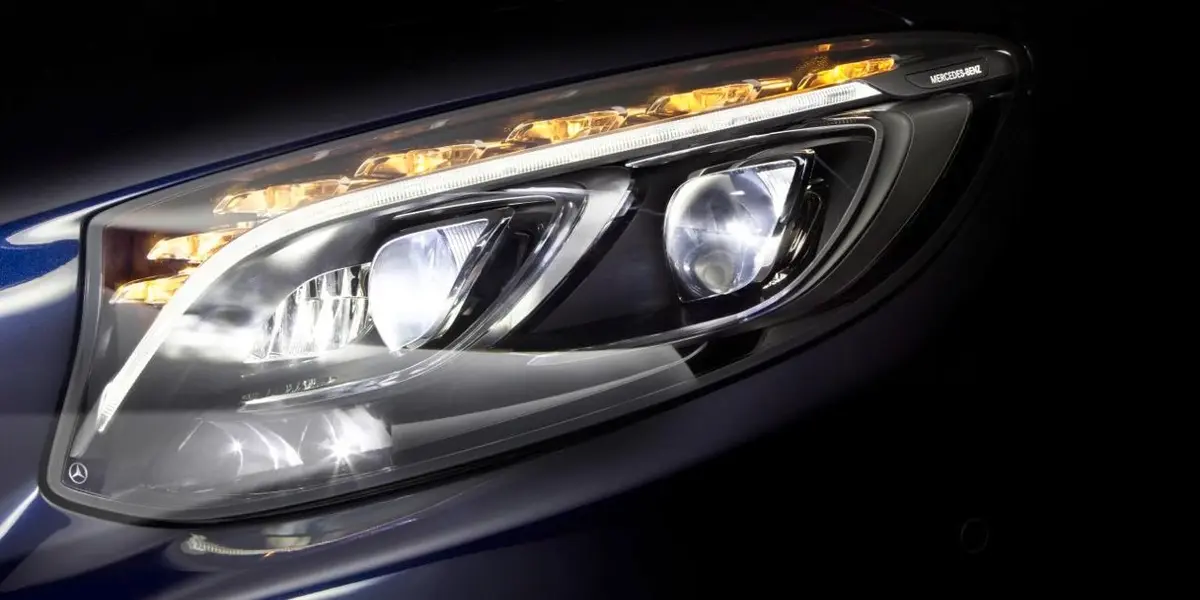
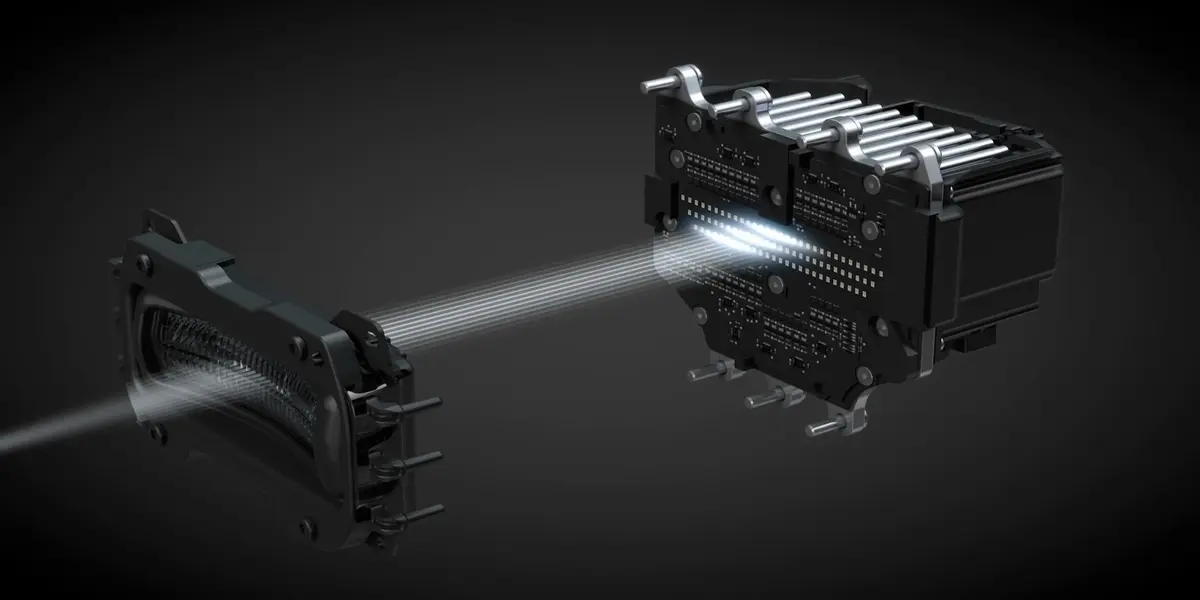
The name describes a module, not a bulb. Behind the lens sits a precision grid of high performance LEDs arranged in rows, and every one of them can be switched independently of its neighbours. The headlight stops being a lamp and becomes something closer to a low resolution projector.
On the cars where the system is best known, the E-Class and the G-Class among them, each headlight carries 84 individually controlled LEDs. That means 168 elements across the front of the car, every one of which can be dimmed or cut without touching the rest of the beam. The supplier that developed the module with Mercedes describes them as arranged in three lines behind a single lens.
The number is not fixed across the range. The generation that came before MultiBeam worked with 24 LEDs per headlight, a step Mercedes set out in the press material issued when the technology was introduced. The A-Class version uses 18, and newer designs push the count higher still, towards 100 elements behind a single lens.
So a spec sheet that says MultiBeam LED does not tell you how finely your car can shape its light. A compact model and an S-Class both wear the badge, and the difference between them is the resolution of the grid rather than the presence of the technology.
The practical gain over older adaptive headlights is that nothing has to move. Earlier systems swung a reflector or dropped a mechanical shutter to shape the beam, which limited how quickly and how precisely the pattern could change. Switching individual LEDs removes both limits at once.
That matters when you compare two cars, or when you read a review of a model you do not own. What the system can do is set by the hardware in your headlight and by the software that drives it, and those two things do not always match.
How the system reads the road
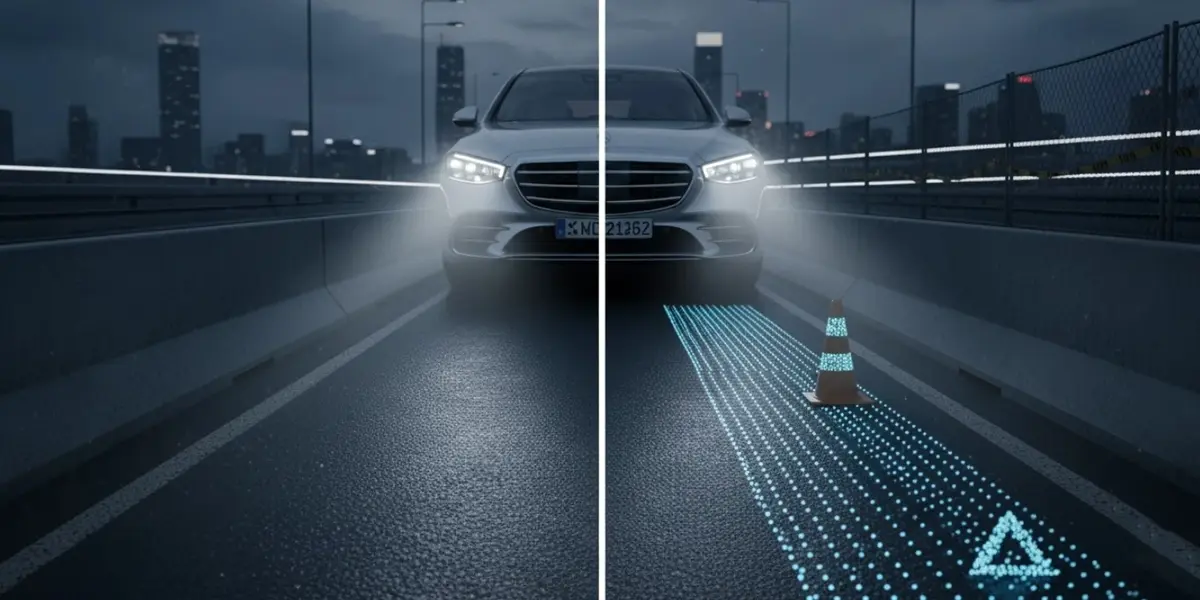
The input comes from a forward facing camera mounted behind the windscreen. It looks for the headlights of oncoming traffic and the tail lights of the car in front, and passes their positions to the control unit that manages the beam.
From there the calculation runs continuously. Mercedes puts numbers on it in its own press information on the system, describing four control units per vehicle that calculate the ideal light pattern a hundred times per second and drive all 84 high performance LEDs in each grid module individually.
The same release puts the partial high beam output at up to two and a half times that of the systems prevalent on the market when it was introduced. That is the figure behind the impression owners describe, that the road simply carries on further than it used to.
In practice the high beam stays on, the road ahead stays lit, and a dark window travels along the road with the other car inside it. The driver ahead never sees the main beam, and the driver behind the wheel does not touch the stalk.
The system depends on that camera seeing clearly, which sets its practical limits. Heavy spray, a dirty windscreen or a vehicle whose lights are obscured can all delay the reaction, and the car falls back on more conservative behaviour when it is unsure. This is normal and not a sign of a fault.
The system also runs a self calibration when the car is started after dark. The beam pattern scans up and down for a moment before it settles, and most owners notice this long before they notice the masking itself.
The functions MultiBeam can run
Adaptive masking is the headline, but it is one item on a longer list. The same grid of individually addressable LEDs lets the car change the entire shape of the beam for the road it is on, and Mercedes ships a set of distinct lighting programmes built on that ability.
Which of them your car offers depends on the model, the build year and the equipment it left the factory with. The list below covers the functions that appear across MultiBeam equipped Mercedes models.
- Glare-free adaptive high beam, which masks other road users while the main beam stays on
- Active light function, which swings the beam towards the direction of travel
- Cornering light, which lights the inside of a turn at low speed
- Motorway mode, which raises and narrows the beam at higher speeds
- Country road light, tuned for unlit two lane roads
- Enhanced fog light, which drops the beam on the driver’s side to cut reflection
- Adverse weather light, which reduces glare from wet surfaces
- City light, a wider and shorter pattern for built up areas
- Extended range high beam, which pushes illumination further down an empty road
Comparing that list with your own car usually shows a gap. Most owners recognise the cornering light straight away, because it is easy to see at a junction, and have never knowingly experienced the masking, because their car switches the high beam off instead.
Almost none of these are things you switch on deliberately. The car selects the programme from speed, steering angle, ambient light and what the camera sees, and the driver’s only real control is whether the automatic high beam is armed at all. This is why a car can offer the functions without the driver ever identifying them.
That difference is not a fault and it is not a problem. It comes down to what the car was configured to do when it was built, which is the subject of two of the sections below.
MultiBeam against High Performance LED
Almost every Mercedes buyer who considers MultiBeam is really choosing between it and the tier below it, which the brand sells as LED High Performance. On paper the two look close, and a brochure rarely explains what the price difference actually buys.
In factory documentation the two options carry different equipment codes, and the values you will see quoted are 632 for LED High Performance and 642 for MULTIBEAM LED. Codes vary between markets and model years, so treat them as a starting point for a check rather than a fact about your own car.
| Capability | LED High Performance | MultiBeam LED |
|---|---|---|
| Automatic high beam | Yes | Yes |
| Partial masking of other road users | No | Yes, where enabled |
| Individually controlled LEDs | No | Yes |
| Cornering and active light | Limited | Yes |
| Road specific beam programmes | No | Yes |
The row that matters is the second one. Owners who have driven both consistently report that the difference is not brightness, and that a good High Performance headlight throws plenty of light. What it cannot do is keep the main beam burning while carving a hole around the car in front.
On a used listing the distinction is rarely spelled out, and photographs will not settle it either. Sellers routinely describe any LED headlight as adaptive, so the equipment list for the VIN is the only description worth acting on when the difference matters to you.
On a lit road, or in traffic, you would struggle to tell the two apart. On an empty country road at night the gap opens up, because one system spends most of its time on dipped beams and the other does not.
Where Digital Light fits
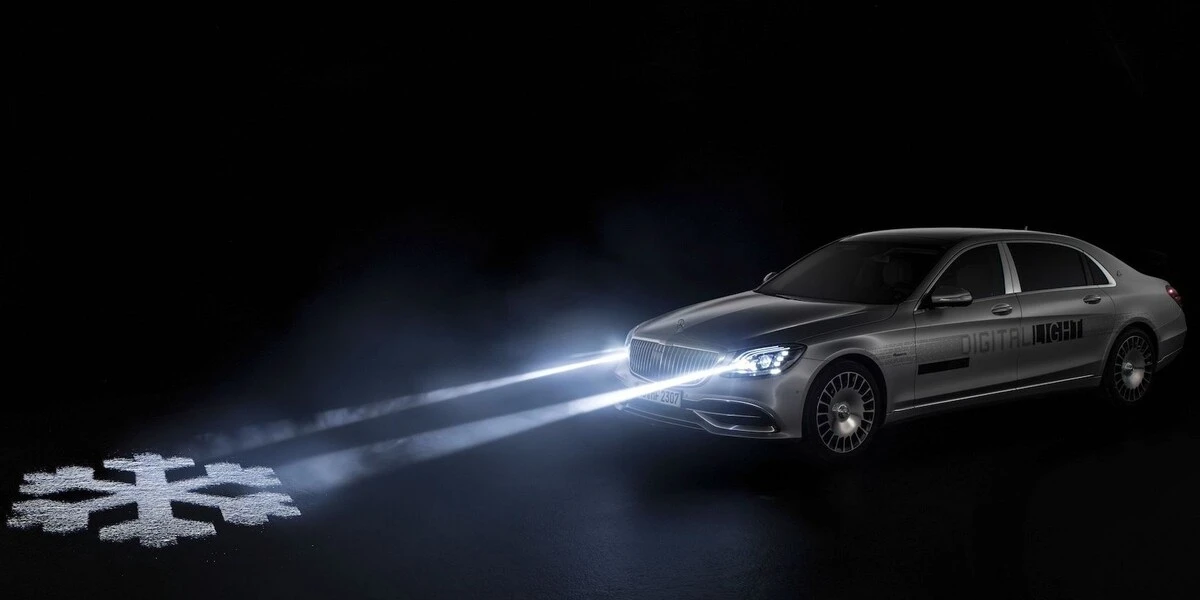
Above MultiBeam sits Digital Light, which replaces the LED grid with a micro-mirror array and turns the headlight into a genuine projector. It can put symbols and warnings on the road surface, mark a lane, or draw a guide line towards an obstacle.
It is also a rare option, offered on a narrow part of the range and taken by a small share of buyers. Comparisons between MultiBeam and Digital Light therefore describe a choice that very few owners were ever offered.
For the overwhelming majority of Mercedes drivers the meaningful comparison is the one in the previous section. Digital Light is worth knowing about, but it is not the option sitting next to MultiBeam on the order form.
Which Mercedes models have it
Availability is decided by chassis code and build year rather than by model name, because the same badge often spans two different electrical platforms. The table below lists the families where MultiBeam is commonly found and for which activation modules exist.
| Chassis | Models | Years |
|---|---|---|
| W205 | C200 to C400, C43 and C63 AMG | 2014-2020 |
| W212, W213 | E200 to E450, E43, E53 and E63 AMG | 2014-2023 |
| W218, C257 | CLS350d to CLS550, CLS53 and CLS63 AMG | 2015-2023 |
| W222 | S350d, S400, S450, S500, S560, S63 AMG | 2014-2020 |
| X253 | GLC43 and GLC63 AMG | 2017-2023 |
| W166, V167 | GLE350 to GLE580, GLE43 to GLE63 AMG | 2016-2026 |
| X166, X167 | GLS350d to GLS580, GLS63 AMG | 2016-2023 |
| W463 | G500, G550, G63 AMG | 2018-2023 |
| X290 | AMG GT43, GT53, GT63 and GT63 S | 2018-2023 |
Cars built around a facelift are the ones worth checking properly. A model refresh often brings a new head unit generation with it, and two cars wearing the same badge and separated by a single model year can behave differently.
Market matters as much as year. The same chassis could be built with MultiBeam for one region and with the tier below it for another, and cars move between markets during their lives. A German car sold on to a buyer abroad keeps the configuration it was built with.
The years above describe the window in which MultiBeam appears on that chassis, not a guarantee that every car in it left the factory with the option. Plenty of them did not, which is why the check in the next section is worth doing before anything else.
How to tell what your car has
Looking at the headlight rarely settles it. Mercedes uses similar lens and daytime running light shapes across both options, and by the time a car reaches a second owner the original window sticker is usually long gone.
There are two things that actually answer the question, and they answer different halves of it. One tells you what hardware is fitted, the other tells you what software generation is running it, and you need both before any conclusion about functions.
- Pull the equipment list tied to the VIN and look for the lighting option
- Identify the infotainment generation from the screen and the menu structure
- Compare what the car offers against the function list above
The two points below cover the first and second of those steps in turn, because that is where owners most often go wrong. The third one follows on its own once the first two are settled.
The equipment code
Every Mercedes carries a list of the optional equipment it was built with, tied to the VIN. That list is where MultiBeam either appears or does not, and it is the only record that reflects the car as it left the production line rather than as a seller describes it.
You will see several code numbers quoted for MultiBeam across forums and retailer listings, and they do not all agree with each other. Rather than trusting a number you found online, pull the equipment list for your own VIN, and read the owner’s manual for your model and year to see which lighting functions it documents.
Dealers can print that list, and independent Mercedes specialists pull it routinely as the first step of any retrofit job. It takes minutes and it removes the guesswork from everything that follows, including whether any further work is possible at all.
The head unit generation
The second half of the answer is the infotainment generation, usually referred to as NTG5, NTG5.5 or MBUX. It determines how lighting settings are stored and presented, and it is the reason two cars on the same chassis can offer different menus.
You can identify it from the screen and the menu structure without any tools. A rotary controller with a COMAND style interface points to the older generations, while the MBUX cars respond to the wake word and put the lighting options in a different place entirely.
Knowing the generation also tells you what to expect from the car in general terms. It governs how settings are stored between drives, which menus exist, and how much of the lighting behaviour is exposed to the driver rather than handled silently in the background.
Why some functions stay switched off
A car can have the full MultiBeam hardware and still never mask an oncoming vehicle. The most common reason has nothing to do with the car itself, and everything to do with the market it was built for.
United States lighting requirements are set by Federal Motor Vehicle Safety Standard No. 108, which was written around headlamps that have a distinct lower beam and a distinct upper beam. A system that continuously reshapes the beam between those two states did not fit the structure of the standard, and American cars were delivered with automatic high beam rather than adaptive masking.
That framework changed in February 2022, when the standard was amended to cover adaptive driving beam headlamps. The rulemaking is published in full as Federal Register document 2022-02451, dated 22 February 2022.
European cars were never shaped by that constraint, which is why an owner in Germany and an owner in Florida can describe the same headlight in completely different terms. It also explains why imported cars sometimes behave unlike their local equivalents.
Equipment level plays its own part alongside the market. Two cars built in the same year for the same country can differ because one was ordered with a lighting package and the other was not, and that difference sits in the configuration rather than in anything visible on the car.
If you are comparing your own car with a review, a video or a friend’s example, the market each car was built for is worth establishing before you conclude that something is broken.
Replacing headlights or activating them
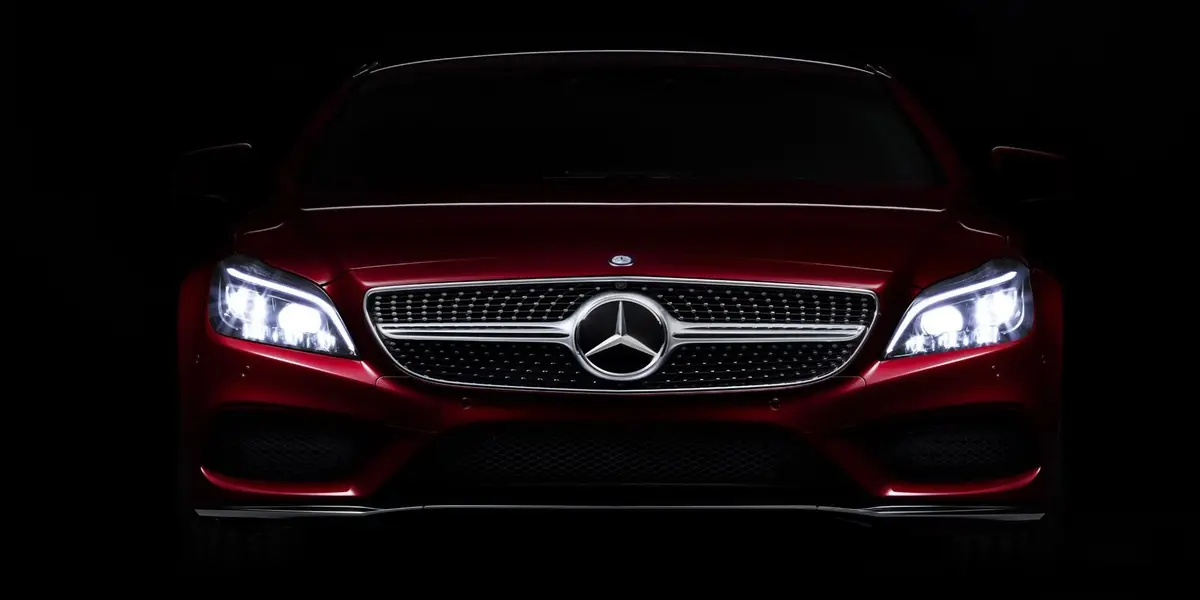
There are two very different ways to end up with more MultiBeam functionality, and they sit at opposite ends of the cost scale. The two are regularly confused, and the difference decides what is possible on any given car.
The first is fitting the hardware. A retrofit is never a single part, and every item has to match the car it is going into.
- The headlamp units themselves
- Headlamp levelling sensors
- LED voltage converters
- The wiring loom and seals
A genuine MultiBeam headlight for a W213 runs to roughly 1,400 dollars for one side, so the parts alone reach four figures before labour and coding. The installation then has to be configured to the car, which is specialist work rather than a bolt-on job.
The second applies only to cars that already have the hardware fitted. Here nothing is replaced. The car is said to enable functions that its own headlights are capable of running, which is what a MultiBeam LED activation module does through the diagnostic port.
A workshop route exists between the two. An independent specialist with dealer level diagnostic software can perform the same kind of configuration change, usually priced by the hour, which makes sense if you want several jobs done in one visit rather than one setting changed on its own.
The distinction is worth stating plainly. Activation cannot put MultiBeam on a car that was built with High Performance LED headlights, because there is no LED grid to address. It changes what is switched on, not what is installed.
Which of the two applies to you is decided entirely by the check in the previous section, which is why that check comes first.
Conclusion
MultiBeam LED is a grid of individually controlled LEDs, a camera and a control unit that redraws the beam a hundred times a second. What any particular car does with that hardware depends on its model, its build year and the market it was sold in.
Work through it in order. Pull the equipment list for your VIN, identify the head unit generation, then compare what your car offers against the function list above. That sequence answers the question far faster than any general guide can.